Showing posts with label Travancore kerala. Show all posts
Showing posts with label Travancore kerala. Show all posts
Friday, November 9, 2012

Wednesday, August 17, 2011
Tuesday, July 12, 2011
Sri Padmanabha Swamy temple wealth belongs to God - Marthanada Varma Thampuran
Marthanda Varma, the eldest member of the Travancore royal family spoke to CNN-IBN in an exclusive interview on all the treasure that was unearthed at the Sree Padmanabhaswamy temple. He feels it should not become such a huge topic of discussion.
Dakshina Muraleedharan: Our country has a long history about invasions and then later how we were plundered by these invaders. Do you believe that the rulers in South India like the Travancore Kings were a step ahead in protecting its people and its wealth?
Marthanada Varma Thampuran: In the South we have been more fortunate. Stronger invasions were in the North. We had mainly trade. We used to trade and supply materials even to Cleopatra. We also had wars. But we were a step ahead. Near the temple there is a bazaar now. A university was situated there then. In the BC era we had education and arms training there. All the other kings - Pandyas, Cholas wanted to know how to defeat us. They said it was because of the university. They came and broke it. Then they wondered how we have this extra capacity. They were told because of the temple. They came to break it but surrendered before the Lord.
My ancestor in 1750 after conquering Venad, it became Travancore, dedicated.the state to Lord Padmnabha. It was called Thiruppadi Dhanam - offering at the sacred step of the Lord. And he ruled the state as his servant. Now as a tourist gimmick we call the state God's own country, everything is his creation only.
Dakshina Muraleedharan:Your counsel told the Supreme Court last week that the royal family does not have any claim on the wealth. Everything is the Lord's property. Help us understand this statement.
Marthanada Varma Thampuran:: I am wearing a dhoti... this comes from cotton.. cotton comes from the earth.. where did the earth come from... from God. Everything belongs to him. We are only people who have the privilege of using what he has been gracious enough to give. That we are forgetting…Many inhibitions that other people have we did not have. It was just service.
Dakshina Muraleedharan: There is a lot of public debate on the development in the temple. Are you saddened or surprised by this variety of opinions pouring in?
Marthanada Varma Thampuran: No Comment because that is for everybody to assess... I am as human as everybody else is. And If that which you hold in veneration is now become a subject of chit chat I can't understand it.
Dakshina Muraleedharan: So you are saying that the matter is subjudice. You will wait for the Supreme Court verdict on this and then express your opinion?
Marthanada Varma Thampuran: Yes then I will say. Whatever the decision is then I am free to say. Now whatever I say would be coloured in some way by everybody. That I don't want.
Dakshina Muraleedharan: The world is awestruck by the revelations in the temple. But the royal family does not seem to be surprised at all. Why is that?
Marthanada Varma Thampuran: It has been our fortune that we were able to serve. So there is no surprise. Only that we are surprised that other people are surprised.
Dakshina Muraleedharan: Any message that you want to give to the devotees of Sree Padmnabha around the world?
Marthanada Varma Thampuran: If you are a devotee increase your devotion. Don't waste time on unnecessary debate.
Dakshina Muraleedharan: The royal family including yourself are known for your generosity. There is an opinion that atleast a percentage of the wealth should be taken outside the temple and spent on social cause. How would you react to that?
Marthanada Varma Thampuran: That comes to thin ice. I won't comment. Its still in the court. I won't say anything now.
Dakshina Muraleedharan: Does this revelation throw light on the history of South India or the history of the Travancore royal family?
Marthanada Varma Thampuran: Let the Supreme Court decide on that in their own way. The easier way, the comfortable way or the hard way.
Dakshina Muraleedharan: People are also surprised at the fact that this was preserved so well by our erstwhile kings. But its not the same world anymore. Are you like many others concerned about security?
Marthanada Varma Thampuran: Ofcourse security is a necessity. Even at home you need security. When you make people understand... People who are not thinking about anything else other than their body... Know of these things... There is a grave responsibility... And that I believe are being seen to by the right people... In the right way.
Saturday, July 9, 2011
Lord Vishnu's royal servants guard his riches

THIRUVANANTHAPURAM: As Sree Padmanbha Swamy temple's glittering gems are valued and tagged, it's not just the diamonds that shine but also the royal family of the erstwhile princely state of Travancore.
It's an ode to the family's unflinching devotion and integrity that not a penny has gone missing from the billions stored in the cellars of the centuries-old shrine administered by the royals.
Uthradam Thirunal Marthanda Varma, current head of the royal family, refuses to comment on the stock-taking exercise till the last paisa is counted. "Till then, only my eyes would speak," he insists.
What makes the family's story vis-a-vis the temple all the more compelling is that the rulers always knew of the riches, yet never touched them. "The riches are mentioned in the book "Pradhanapetta Mathilakom Records" (Important Mathilakom Records) compiled by acclaimed Malayalam poet Ulloor S Parameswara Iyer and published in 1941. They also figure in the "Kottaram" (Palace) manual which runs into 12 volumes," says noted historian M G Sasibhushan. "These records refer to the sacred cellars from which treasure is being dug out."
Observers talk of the symbolic significance of the practice of royal family members dusting sand off their feet when they emerge from the shrine. "It was meant to convey that the family members would not take home or misappropriate even a speck of sand belonging to Padmanabha," they say. In fact, the present head, Uthradom Thirunal Marthanda Varma, religiously follows the rule of paying of Rs 151 and 55 paise to the temple if he fails to make it to the shrine on any day.
Unlike other royals, the Travancore family has stayed away from opulence with descendants more inclined towards art and culture.
"There was also a rule that the affairs of the palace should be run from the proceeds of its spice business and not with money from the state treasury," says Sasibhushan. This is followed even now. The present ruler's nephew Moolam Thirunal Rama Varma, next in line to head the family, runs the Aspinwall Company, which to this day supplies pepper to Buckingham Palace and many more European royals," Sasibhushan says.
Though the kingdom of Travancore lapsed in 1949 following the Instrument of Accession with the Union of India, the management of the temple remained with the royal family by virtue of a covenant.
Travancore extended from Kanyakumari (now in Tamil Nadu) in the south to Aluva (Ernakulam district) in the north. Padmanabhapuram (now in TN) was its first capital, but this was shifted to Thiruvananthapuram by Karthika Thirunal Rama Varma, better known as Dharma Raja, so called because he refused to let go of refugees who had fled Malabar following Tipu Sultan's onslaught. He succeeded Anizham Thirunal Marthanda Varma, first ruler of Travancore, and is credited with formation of the state.
The family, which ruled over erstwhile Travancore, has had a long lineage of visionary rulers. In fact, it was a bold move by the first Marthanda Varma in 1750 that inextricably bonded the temple and the palace. The king donated the wealth of the kingdom to the deity Padmanabha (Lord Vishnu) and ruled the state as "Padmanabha Dasa" (servant of
Padmanabha).
Tuesday, July 5, 2011
Monday, July 4, 2011
Maha Raja Swathi Thirunal Rama Varma
Sri Swathi Thirunal Rama Varma (April 16, 1813 - December 25, 1846) was the Maharaja of the state of Travancore in India. He reigned under the regency of his mother Maharani Gowri Lakshmi Bayi from 1813 till 1815 and henceforth under the regency of his aunt Maharani Gowri Parvati Bayi from 1815 till 1829. In 1829 he turned major and assumed full powers of ruler and ruled Travancore till his demise in 1846.
Besides being an able ruler, he was a patron of music and a musician himself. He encouraged both broad systems of Indian music, Hindustani and Carnatic music, though he was essentially a connoisseur of the Carnatic music tradition. He is credited with composing over 400 compositions in Carnatic music as well as Hindustani music. Some of his favorite compositions are Padmanabha Pahi, Deva Deva, Sarasijanabha and Sree Ramana Vibho. The king was fluent in a number of languages such as Malayalam, Sanskrit, Hindi, Marathi, Telugu, Kannada, Bengali, Tamil, Oriya and English.
The Astronomical Observatory in Thiruvananthapuram, the Museum & Zoo, the Government Press, Trivandrum Public Library (now State Central Library), the Oriental Manuscript Library, etc. were started by Swathi Thirunal. The Maharajah was also an honorary member of the Royal Asiatic Society from 1843.
Swathi Thirunal (as he is commonly known) was born into the Kulasekhara dynasty of the Royal family of Travancore state, which is now a part of Kerala State in India) on April 16, 1813. He was the second child of the Regent Queen Gowri Lakshmi Bayi who ruled Travancore during 1811 - 1815, and Rajaraja Varma Koyithampuran of Changanasseri Palace. The famous poet and composer and close relative Iraiyamman Tampi wrote the song Omanathinkalkkitavo nalla komalathamarappuvo , perhaps the most famous lullaby in Malayalam, about Swathi Thirunal when he was born. He had an elder sister (Rukmini Bai) and a younger brother (Uthram Thirunal Marthanda Varma). Rani Gowri Lakshmi Bayi died about two months after the birth of her third child. After her death, her younger sister Gowri Parvati Bayi was in charge of the state and the children. Since Rama Varma was just seventeen months old when his mother died, Gowri Parvati Bayi ruled for fourteen years before Swathi Thirunal took over as the king. When he was just four months old, his mother invited Col. Munro (who was the representative of the British East India Company) and his officials and declared in the Durbar that she was entrusting the British East India Company with the care of her child and expected the Company to co-operate with him in future.
Both his aunt/foster mother, who was well-versed in music, and his father, a Sanskrit scholar. took special care about his education. Col. Munro also is said to have taken interest in his education. He started learning Malayalam and Sanskrit at the age of six and English at the age of seven. The young Prince studied several languages, including Malayalam, Kannada, Tamil, Hindustani, Telugu, Marathi, Sanskrit, English and Persian. He impressed all his teachers, and even guests from abroad, with his keen understanding of not only languages but also other subjects like geometry. P. Sankunni Menon (A History of Travancore from the Earliest Times, 1878) records an incident when Swathi Thirunal told Col. Welsh, a visiting British officer, that the word geometry and words like hexagon, septagon and so on were derived from Sanskrit.
Swathi Thirunal was deeply interested in music right from childhood. He tried to learn the languages in which he found good music. His education in music started with the first lessons from Karamana Subrahmania Bhagavathar and Karamana Padmanabha Bhagavathar. Later, he studied music from his English teacher Subbarao. He continued to learn music by listening to accomplished musicians and practicing himself. This was a period when music and art were thriving in many parts of south India. The triumvirate of Carnatic music, Tyagaraja (1767–1847), Syama Sastri (1762–1827) and Muthuswami Dikshitar (1775–1835), lived and enriched music during this period. Swati Tirunal's palace also was home to many musicians and artistes of the period, including the famous Thanjavur Quartet brothers, Tyagaraja's disciple Kannayya Bhagavathar, Ananthapadmanabha Goswami (a Maharashtrian singer known as Kokilakanthameru swami), Shadkala Govinda Marar, and many others.
Swathi Sangeethotsavam
Prince Rama Varma

Prince Rama Varma, the South Indian Classical Musician, is a descendent of Maharaja Swathi Thirunal. He is the organiser for Swathi Sangeethotsavam, a week long music festival featuring exclusively the compositions of Swathi Thirunal. This unique musical event is conducted every year from 6 to 12 January at Kuthira Malika, Trivandrum.
Swathi Thirunal took over the reins of Travancore from his aunt (She was the regent in lieu Swathi Thirunal in his boyhood) at he age of sixteen. He appointed his teacher Subbarao as the chief minister (Diwan). One of his first moves was to shift the government secretariat from Kollam (about seventy five kilometres away) to Thiruvananthapuram. This enabled him to give personal attention to government affairs. He took steps to curb corruption in the government, and told even the Diwan to resign when he heard that the Diwan had acted to favour a particular party in a land dispute. He started an English school at Thiruvananthapuram in 1834, which came to be called the Raja's Government Free School and later became Maharaja's High School and then Maharaja's College. This is now the University College. Later, similar schools were started at many other places. He also implemented reforms in the legal sector, starting Munsif, District and Appellate Courts and modernising laws. He identified one Kandan Menon from Malabar and appointed him as Huzoor Diwan Peshkar to bring about legal reforms. Another of his achievements was to settle many land disputes by carrying out a resurvey of the land, in which also Menon helped him. He also conducted the first census of the state in 1836. As per the census, the population of Travancore was 1,28,068.
Kuthira Malika, Thiruvananthapuram, constructed by Maharajah Swathi ThirunalSwathi Thirunal was also instrumental in bringing modern medicine to the state. He appointed a European as the palace physician. He was also given the responsibility of providing medical assistance to local people, for which hospitals were started. It is this post that was known as Surgeon General till the formation of Kerala State. He also started an engineering department, which was placed under the command of one Lieutenant Horsley. The Karamana bridge was built at that time.
Another area where Swathi Thirunal took interest was in astronomy. He wished to compare Western findings with Indian knowledge. For this, he invited one Caldecott, an industrial representative who lived in Alapuzha, who used to fabricate instruments for astronomical observations. Finding that there was much common between western and Indian knowledge about the universe, Swathi Thirunal started an observatory and placed Caldecott in charge. Started in 1837, some of the equipment is still to be seen at the Thiruvananthapuram observatory (now under the Department of Physics, University of Kerala). He is also credited with starting the first government press (the only press at that time was CMS Press in Kottayam), and the museum and zoo in Thiruvananthapuram.
Family
Maharajah Swathi Thirunal was only a child when his mother Maharani Gowri Lakshmi Bayi died and he grew up under the maternal care of his childless aunt, who was the Regent of Travancore on his behalf, Maharani Gowri Parvati Bayi. He had a brother, Uthram Thirunal Marthanda Varma, who succeeded him in 1846 till his demise in 1860. The Maharajah also had a sister, Maharani Gowri Rukmini Bayi, whose children ascended the Travancore musnud consecutively. Her only daughter was the mother of Maharajah Moolam Thirunal Sir Rama Varma.
Swathi Thirunal married Thiruvattar Ammachi Panapillai Amma Srimathi Narayani Pillai Kochamma of the Thiruvattar Ammaveedu family after the demise of his first wife. She was an expert carnatic singer and Veena player. She originally belonged to an ordinary Nair family in Quilon by the name of Aaikutty Veedu. Prior to her marriage with the king she was adopted into the Thiruvattar Ammaveedu along with her mother and siblings (her sister was married to the Maharajah's brother and successor Uthram Thirunal). From this marriage the Maharajah had a son, Thiruvattar Chithira Nal Anantha Padmanabhan Chempakaraman Thampi. In 1843 the Maharajah married Sundara Lakshmi Ammal, daughter of a Mudaliar who had migrated to Trivandrum. Lakshmi was a dancer, known better as Sugandhavalli. The Maharajah first adopted her into Vadasseri Ammaveedu, making her an Ammachi and bestowing the title of Thampi on her family members. In 1845 he constructed the Thanjavur Ammaveedu and Sugandhavalli, along with her family members resided here. The Maharajah's second wife, Thiruvattar Ammachi, whose sister was married to Uthram Thirunal did not approve of this marriage. Soon after in 1846 the Maharajah died. Legend and folklore has it that Sugandhavalli was banished from Travancore following which the Maharajah died broken hearted. However facts and records prove otherwise.
Sugandhavalli continued to live in Trivandrum at Thanjavur Ammaveedu until her own death in 1856, a full decade after the death of Swathi Thirunal, enjoying all the provisions and privileges she was entitled to as a royal consort. However soon after her death, her late husband's brother and successor, Maharajah Uthram Thirunal issued an order to attach the estate and properties that belonged to Thanjavur Ammaveedu on the ground that Sugandhavalli for whom they were made, had died. Sugandhavalli's sister Sundara Parvathi Pillai Thankachi, who had been married to Singaravelu Mudaliyar the former Alleppey District Judge, then filed a petition in Madras. The High Court of Madras in 1858 permitted the Travancore Government to attach the properties after compensating the family. Accordingly Rs. 10,000, a princely sum, was given to Sugandhavalli's family and the Thanjavur Ammaveedu taken over by the Travancore Government. The Ganapathi idol worshiped by Sugandhavalli was moved and consecrated at the Palkulangara Temple in Trivandrum. Her sister later died in 1883 (This information is from "Thiruvananthapurathinte Eithihaasam").
Besides being an able ruler, he was a patron of music and a musician himself. He encouraged both broad systems of Indian music, Hindustani and Carnatic music, though he was essentially a connoisseur of the Carnatic music tradition. He is credited with composing over 400 compositions in Carnatic music as well as Hindustani music. Some of his favorite compositions are Padmanabha Pahi, Deva Deva, Sarasijanabha and Sree Ramana Vibho. The king was fluent in a number of languages such as Malayalam, Sanskrit, Hindi, Marathi, Telugu, Kannada, Bengali, Tamil, Oriya and English.
The Astronomical Observatory in Thiruvananthapuram, the Museum & Zoo, the Government Press, Trivandrum Public Library (now State Central Library), the Oriental Manuscript Library, etc. were started by Swathi Thirunal. The Maharajah was also an honorary member of the Royal Asiatic Society from 1843.
Swathi Thirunal (as he is commonly known) was born into the Kulasekhara dynasty of the Royal family of Travancore state, which is now a part of Kerala State in India) on April 16, 1813. He was the second child of the Regent Queen Gowri Lakshmi Bayi who ruled Travancore during 1811 - 1815, and Rajaraja Varma Koyithampuran of Changanasseri Palace. The famous poet and composer and close relative Iraiyamman Tampi wrote the song Omanathinkalkkitavo nalla komalathamarappuvo , perhaps the most famous lullaby in Malayalam, about Swathi Thirunal when he was born. He had an elder sister (Rukmini Bai) and a younger brother (Uthram Thirunal Marthanda Varma). Rani Gowri Lakshmi Bayi died about two months after the birth of her third child. After her death, her younger sister Gowri Parvati Bayi was in charge of the state and the children. Since Rama Varma was just seventeen months old when his mother died, Gowri Parvati Bayi ruled for fourteen years before Swathi Thirunal took over as the king. When he was just four months old, his mother invited Col. Munro (who was the representative of the British East India Company) and his officials and declared in the Durbar that she was entrusting the British East India Company with the care of her child and expected the Company to co-operate with him in future.
Both his aunt/foster mother, who was well-versed in music, and his father, a Sanskrit scholar. took special care about his education. Col. Munro also is said to have taken interest in his education. He started learning Malayalam and Sanskrit at the age of six and English at the age of seven. The young Prince studied several languages, including Malayalam, Kannada, Tamil, Hindustani, Telugu, Marathi, Sanskrit, English and Persian. He impressed all his teachers, and even guests from abroad, with his keen understanding of not only languages but also other subjects like geometry. P. Sankunni Menon (A History of Travancore from the Earliest Times, 1878) records an incident when Swathi Thirunal told Col. Welsh, a visiting British officer, that the word geometry and words like hexagon, septagon and so on were derived from Sanskrit.
Swathi Thirunal was deeply interested in music right from childhood. He tried to learn the languages in which he found good music. His education in music started with the first lessons from Karamana Subrahmania Bhagavathar and Karamana Padmanabha Bhagavathar. Later, he studied music from his English teacher Subbarao. He continued to learn music by listening to accomplished musicians and practicing himself. This was a period when music and art were thriving in many parts of south India. The triumvirate of Carnatic music, Tyagaraja (1767–1847), Syama Sastri (1762–1827) and Muthuswami Dikshitar (1775–1835), lived and enriched music during this period. Swati Tirunal's palace also was home to many musicians and artistes of the period, including the famous Thanjavur Quartet brothers, Tyagaraja's disciple Kannayya Bhagavathar, Ananthapadmanabha Goswami (a Maharashtrian singer known as Kokilakanthameru swami), Shadkala Govinda Marar, and many others.
Swathi Sangeethotsavam
Prince Rama Varma

Prince Rama Varma, the South Indian Classical Musician, is a descendent of Maharaja Swathi Thirunal. He is the organiser for Swathi Sangeethotsavam, a week long music festival featuring exclusively the compositions of Swathi Thirunal. This unique musical event is conducted every year from 6 to 12 January at Kuthira Malika, Trivandrum.
Swathi Thirunal took over the reins of Travancore from his aunt (She was the regent in lieu Swathi Thirunal in his boyhood) at he age of sixteen. He appointed his teacher Subbarao as the chief minister (Diwan). One of his first moves was to shift the government secretariat from Kollam (about seventy five kilometres away) to Thiruvananthapuram. This enabled him to give personal attention to government affairs. He took steps to curb corruption in the government, and told even the Diwan to resign when he heard that the Diwan had acted to favour a particular party in a land dispute. He started an English school at Thiruvananthapuram in 1834, which came to be called the Raja's Government Free School and later became Maharaja's High School and then Maharaja's College. This is now the University College. Later, similar schools were started at many other places. He also implemented reforms in the legal sector, starting Munsif, District and Appellate Courts and modernising laws. He identified one Kandan Menon from Malabar and appointed him as Huzoor Diwan Peshkar to bring about legal reforms. Another of his achievements was to settle many land disputes by carrying out a resurvey of the land, in which also Menon helped him. He also conducted the first census of the state in 1836. As per the census, the population of Travancore was 1,28,068.
Kuthira Malika, Thiruvananthapuram, constructed by Maharajah Swathi ThirunalSwathi Thirunal was also instrumental in bringing modern medicine to the state. He appointed a European as the palace physician. He was also given the responsibility of providing medical assistance to local people, for which hospitals were started. It is this post that was known as Surgeon General till the formation of Kerala State. He also started an engineering department, which was placed under the command of one Lieutenant Horsley. The Karamana bridge was built at that time.
Another area where Swathi Thirunal took interest was in astronomy. He wished to compare Western findings with Indian knowledge. For this, he invited one Caldecott, an industrial representative who lived in Alapuzha, who used to fabricate instruments for astronomical observations. Finding that there was much common between western and Indian knowledge about the universe, Swathi Thirunal started an observatory and placed Caldecott in charge. Started in 1837, some of the equipment is still to be seen at the Thiruvananthapuram observatory (now under the Department of Physics, University of Kerala). He is also credited with starting the first government press (the only press at that time was CMS Press in Kottayam), and the museum and zoo in Thiruvananthapuram.
Family
Maharajah Swathi Thirunal was only a child when his mother Maharani Gowri Lakshmi Bayi died and he grew up under the maternal care of his childless aunt, who was the Regent of Travancore on his behalf, Maharani Gowri Parvati Bayi. He had a brother, Uthram Thirunal Marthanda Varma, who succeeded him in 1846 till his demise in 1860. The Maharajah also had a sister, Maharani Gowri Rukmini Bayi, whose children ascended the Travancore musnud consecutively. Her only daughter was the mother of Maharajah Moolam Thirunal Sir Rama Varma.
Swathi Thirunal married Thiruvattar Ammachi Panapillai Amma Srimathi Narayani Pillai Kochamma of the Thiruvattar Ammaveedu family after the demise of his first wife. She was an expert carnatic singer and Veena player. She originally belonged to an ordinary Nair family in Quilon by the name of Aaikutty Veedu. Prior to her marriage with the king she was adopted into the Thiruvattar Ammaveedu along with her mother and siblings (her sister was married to the Maharajah's brother and successor Uthram Thirunal). From this marriage the Maharajah had a son, Thiruvattar Chithira Nal Anantha Padmanabhan Chempakaraman Thampi. In 1843 the Maharajah married Sundara Lakshmi Ammal, daughter of a Mudaliar who had migrated to Trivandrum. Lakshmi was a dancer, known better as Sugandhavalli. The Maharajah first adopted her into Vadasseri Ammaveedu, making her an Ammachi and bestowing the title of Thampi on her family members. In 1845 he constructed the Thanjavur Ammaveedu and Sugandhavalli, along with her family members resided here. The Maharajah's second wife, Thiruvattar Ammachi, whose sister was married to Uthram Thirunal did not approve of this marriage. Soon after in 1846 the Maharajah died. Legend and folklore has it that Sugandhavalli was banished from Travancore following which the Maharajah died broken hearted. However facts and records prove otherwise.
Sugandhavalli continued to live in Trivandrum at Thanjavur Ammaveedu until her own death in 1856, a full decade after the death of Swathi Thirunal, enjoying all the provisions and privileges she was entitled to as a royal consort. However soon after her death, her late husband's brother and successor, Maharajah Uthram Thirunal issued an order to attach the estate and properties that belonged to Thanjavur Ammaveedu on the ground that Sugandhavalli for whom they were made, had died. Sugandhavalli's sister Sundara Parvathi Pillai Thankachi, who had been married to Singaravelu Mudaliyar the former Alleppey District Judge, then filed a petition in Madras. The High Court of Madras in 1858 permitted the Travancore Government to attach the properties after compensating the family. Accordingly Rs. 10,000, a princely sum, was given to Sugandhavalli's family and the Thanjavur Ammaveedu taken over by the Travancore Government. The Ganapathi idol worshiped by Sugandhavalli was moved and consecrated at the Palkulangara Temple in Trivandrum. Her sister later died in 1883 (This information is from "Thiruvananthapurathinte Eithihaasam").
Padmanabha Dasas -The Travancore Royal Family
The Travancore royal family style themselves as Padmanabha Dasas or servants of Padmanabha since 1750 when Maharajah Marthanda Varma made over the state to the deity of the Sri Padmanabhaswamy Temple and vowed that from that day on, the royal family would rule the state on behalf of Sri Padmanabhaswamy. The title of Padmanabha Dasa is prefixed to the name of every Travancore King while females call themselves Padmanabha Sevinis. This important donation of the state to the temple was known as Thripadidanam. The British government accorded the Maharajah of Travancore a high 19 gun salute, whereas for all temple festivals, the highest salute of 21 guns was fired.
Travancore Kings
Marthanda Varma 1729-1758
Dharma Raja 1758-1798
Balarama Varma 1798-1810
Gowri Lakshmi Bayi‡ 1810-1815
Gowri Parvati Bayi‡ 1815-1829
Swathi Thirunal 1829-1846
Uthram Thirunal 1846-1860
Ayilyam Thirunal 1860-1880
Visakham Thirunal 1880-1885
Moolam Thirunal 1885-1924
Sethu Lakshmi Bayi‡ 1924-1931
Chithira Thirunal 1931-1949

Palaces
Padmanabhapuram Palace

Kilimanoor palace

Kuthira Malika

Kowdiar Palace

The Padmanabhapuram Palace was the main residence of the Travancore Maharajahs whereas the Ranis of Attingal resided at that place in their own palaces. Later the royal family moved to Trivandrum wherein the females resided at the Sree Padam Palace. Presently the Royal family members live at Kowdiar Palace in Trivandrum and at Chennai, Bangalore etc. Some members are also settled abroad in the United States of America, Australia, South Africa etc.
Adoption
HH Maharani Sethu Parvathi Bayi, Junior Rani of Attingal, adopted in 1900, along with her consort M.R.Ry Ravi Varma Kochu Koil Thampuran on their wedding day in 1906The first adoption to the Travancore Royal Family was in the early 14th century from the Kolathiri family. Since then the senior most females of the family are styled as the Ranis of Attingal with the titles of Attingal Mootha Thampuran (Senior Rani of Attingal) and Attingal Elaya Thampuran (Junior Rani of Attingal).[7] This adoption resulted by the late 17th century in the branching of the Royal family into four families namely the branch at Trivandrum, another at Kottarakara known as Elayadathu Swaroopam, the Peraka Thavazhi branch of Nedumangad and the Quilon branch. The later two branches died out into the 18th century whereas the last Rani of Kottarakara fled after battle with Marthanda Varma.[8] In 1630 two males were adopted from the Cochin Royal Family [9] sowing the seed of dissension between the branches of the Royal family. Later in 1684 one male and two females were adopted from the Kolathiri family, from which family all subsequent adoptions were made, by Umayamma Rani.[10] In 1688 two males, including
Rajah Rama Varma, and two females were adopted and Marthanda Varma was born to one of these princesses.[11] In 1718 a princess was adopted, whose son was the later king Dharma Raja and whose great grandson was the poet Irayimman Thampi . In 1748 again four princesses were adopted and Balarama Varma (1798–1810) belonged to this line.[12] The next adoption of 1788 brought forth the famous Maharanis, Gowri Lakshmi Bayi and Gowri Parvati Bayi and all the male rulers up to 1924, the last ruler in this line being Moolam Thirunal.[13] In 1857 two princesses, including Rani Lakshmi Bayi, were adopted from a branch of the Kolathiri family residing at Mavelikara since the 1790s, but by 1901 both these princesses and all their issue died.[14] In 1900 again two princesses were adopted from Mavelikara, granddaughters of Raja Ravi Varma, including the Maharani Sethu Lakshmi Bayi.[15] The latest adoption occurred in 1994.
Travancore Kings
Marthanda Varma 1729-1758
Dharma Raja 1758-1798
Balarama Varma 1798-1810
Gowri Lakshmi Bayi‡ 1810-1815
Gowri Parvati Bayi‡ 1815-1829
Swathi Thirunal 1829-1846
Uthram Thirunal 1846-1860
Ayilyam Thirunal 1860-1880
Visakham Thirunal 1880-1885
Moolam Thirunal 1885-1924
Sethu Lakshmi Bayi‡ 1924-1931
Chithira Thirunal 1931-1949

Palaces
Padmanabhapuram Palace

Kilimanoor palace

Kuthira Malika
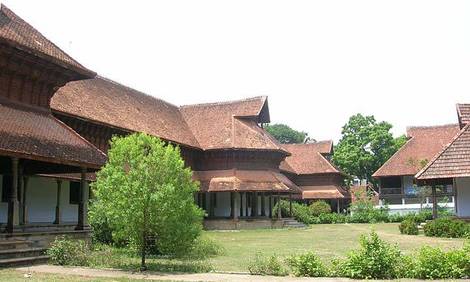
Kowdiar Palace

The Padmanabhapuram Palace was the main residence of the Travancore Maharajahs whereas the Ranis of Attingal resided at that place in their own palaces. Later the royal family moved to Trivandrum wherein the females resided at the Sree Padam Palace. Presently the Royal family members live at Kowdiar Palace in Trivandrum and at Chennai, Bangalore etc. Some members are also settled abroad in the United States of America, Australia, South Africa etc.
Adoption
HH Maharani Sethu Parvathi Bayi, Junior Rani of Attingal, adopted in 1900, along with her consort M.R.Ry Ravi Varma Kochu Koil Thampuran on their wedding day in 1906The first adoption to the Travancore Royal Family was in the early 14th century from the Kolathiri family. Since then the senior most females of the family are styled as the Ranis of Attingal with the titles of Attingal Mootha Thampuran (Senior Rani of Attingal) and Attingal Elaya Thampuran (Junior Rani of Attingal).[7] This adoption resulted by the late 17th century in the branching of the Royal family into four families namely the branch at Trivandrum, another at Kottarakara known as Elayadathu Swaroopam, the Peraka Thavazhi branch of Nedumangad and the Quilon branch. The later two branches died out into the 18th century whereas the last Rani of Kottarakara fled after battle with Marthanda Varma.[8] In 1630 two males were adopted from the Cochin Royal Family [9] sowing the seed of dissension between the branches of the Royal family. Later in 1684 one male and two females were adopted from the Kolathiri family, from which family all subsequent adoptions were made, by Umayamma Rani.[10] In 1688 two males, including
Rajah Rama Varma, and two females were adopted and Marthanda Varma was born to one of these princesses.[11] In 1718 a princess was adopted, whose son was the later king Dharma Raja and whose great grandson was the poet Irayimman Thampi . In 1748 again four princesses were adopted and Balarama Varma (1798–1810) belonged to this line.[12] The next adoption of 1788 brought forth the famous Maharanis, Gowri Lakshmi Bayi and Gowri Parvati Bayi and all the male rulers up to 1924, the last ruler in this line being Moolam Thirunal.[13] In 1857 two princesses, including Rani Lakshmi Bayi, were adopted from a branch of the Kolathiri family residing at Mavelikara since the 1790s, but by 1901 both these princesses and all their issue died.[14] In 1900 again two princesses were adopted from Mavelikara, granddaughters of Raja Ravi Varma, including the Maharani Sethu Lakshmi Bayi.[15] The latest adoption occurred in 1994.
Subscribe to:
Posts (Atom)